August 28, 2025 · 10min read
What is Enterprise Fraud Management (EFM): Strategies and Emerging Trends


If you want to secure your house from intruders, your first move would be to lock your door, right? It’s a smart first step. But determined criminals aren’t easily deterred. Bad actors will find other entry points, such as windows or vents, or use fake names or identities to gain entrance under false pretenses. Data from the US Federal Trade Commission (2025) found fraud losses recently reached $12.5 billion in the US, a 25% jump from the previous year.1 As criminals seek to exploit every available banking channel, banks and financial institutions should prioritize enterprise fraud management to safeguard their banking channels from threats.
In this article, we’ll dive deep into how enterprise fraud management works, notable shifts in the fraud market, and how banks can unlock new opportunities with EFM solutions.
Key Takeaways
- Enterprise Fraud Management is an intelligence-driven approach designed to detect and prevent fraud across an entire organization.
- EFM combines fraud detection efforts across various banking channels (e.g., web, mobile, call centers, etc.), enabling a holistic view of fraudulent activities.
- It also breaks down silos that often come up between fraud prevention and AML teams, fostering greater collaboration.
- Feedzai’s comprehensive lifecycle approach to enterprise fraud management has received industry recognition from top analyst firms, including Chartis and IDC MarketScape.
What is Enterprise Fraud Management (EFM)?
Enterprise Fraud Management, also called EFM, is a comprehensive, intelligence-driven approach designed to detect, prevent, and mitigate fraud across an entire organization. Traditional fraud prevention methods often operate in silos, resulting in fragmented decisioning that allows threats to slip through the cracks, as each system may reach different conclusions without coordinated intelligence. EFM unifies fraud detection efforts across different channels (e.g., web, mobile, call centers, etc.) to provide a holistic view of fraudulent activities.
Think of your organization as your own house. By using a siloed approach to fraud prevention, your bank or financial institution is only focused on one point of entry to your house at a time. EFM is the security system that protects each point of entry into your home simultaneously. Using advanced technologies like AI and machine learning, EFM systems can analyze vast amounts of data in real time, identify suspicious patterns, and swiftly respond to threats.
EFM goes beyond stopping fraud. It’s also essential to protect customer trust and safeguard financial assets while keeping operations efficient. By integrating fraud detection with case management and security orchestration tools, organizations can automate responses, reduce false positives, and accelerate investigations.
Best Enterprise Fraud Solution
Feedzai's AI-powered Transaction Fraud for Banking solution is recognized in the Chartis RiskTech100 2024 report for its unmatched cloud and AI-first approach to fraud prevention.
Perhaps just as importantly, it breaks down barriers between fraud and anti-money laundering (AML) teams, enabling greater intelligence-sharing and improving protection. Teams with different functions and responsibilities can collaborate more easily to address complex attacks, allowing a more robust defense against fraud attacks.
Emerging Trends for Enterprise Fraud Management
Several notable trends are shaping how banks and organizations should consider enterprise fraud management, with a new emphasis on the critical role of data infrastructure and orchestration.
GenAI-driven Fraud and Synthetic Identities
Synthetic identity fraud is a rising threat to banks and customers. Criminals piece together realistic-looking personas using real and fake data. These counterfeit identities are also enhanced by GenAI-powered tools like deepfakes and voice cloning, making them appear even more realistic. Research in 2025 on AI trends from Feedzai found that criminals are using GenAI to launch deepfakes, voice, cloning, and SMS/phishing attacks.
Additionally, Jack Henry notes that fraudsters are also using GenAI to create realistic counterfeit checks.2 An analysis by Deloitte projects synthetic identity fraud losses will reach $2.3 billion by 2030.3 Banks often struggle to develop their own AI-powered fraud prevention solutions. That’s because while many have invested in building their data science teams, they are still using outdated toolkits, hindering their ability to react quickly to emerging threats.
Data Concerns and the Need for Updated Infrastructure
Feedzai’s research found that 90% of financial institutions worldwide are using AI to fight fraud. However, the report also found that data management and accuracy are top challenges for global banks. Concerns over data quality are the most significant barrier to AI adoption for 59% of financial institutions that have not yet embraced the technology. As a result, banks must invest in data infrastructure and governance to handle the volume and sources of data required for effective fraud detection.
Increased Regulatory Pressure
New regulations, especially in regions like the UK’s Payment Systems Regulator, are imposing stricter requirements on financial institutions to prevent fraud and reimburse victims. The PSR requires both receiving and sending financial institutions to evenly split the cost of scam losses, raising pressure on banks to make prevention and inbound payment monitoring central to fraud prevention efforts. This increases risk exposure for institutions with siloed or fragmented decisioning and a limited ability to explain their decisions. EFM will be key to securing banks against fraud and scam losses across multiple channels.
Collaboration and Intelligence Sharing
Shared intelligence has long been discussed as a solution to bring multiple organizations together to prevent fraud. With new initiatives like the launch of Feedzai IQ™ and Meta’s FIRE program, the industry is finally seeing industry-wide collaboration and intelligence sharing become part of banks’ fraud prevention efforts.
EFM systems will be essential to keeping multiple teams informed about new fraud trends across different banking channels. Modern EFM platforms should also enable organizations to securely benefit from global, anonymized threat insights across an entire vendor ecosystem, turning collective intelligence into a real-time defensive advantage. Without this, banks have a limited ability to tap into global fraud insights.
Behavioral Biometrics and Pattern Recognition
A cornerstone of stopping fraud is to know who your customers are at the behavioral level. As digital interactions grow, behavioral biometrics solutions are essential to understanding who is on the other side of a screen. By analysing a user’s typing speed, mouse movements, and the pressure they apply to their touchscreen, banks can confidently answer if a user is really who they claim to be. This both improves fraud detection and reduces false positives. Because it works silently in the background, the customer experiences no interruptions in their journey. This capability offers banks greater agility and the ability to respond to new threats quickly.
Rise in Social Engineering Attacks
Research from GASA found that scams cost customers worldwide $1 trillion in 2024. Social engineering is critical to these tactics. By studying a target’s social media profile or learning their everyday routines, scammers can exploit their victims’ trust with a highly-tailored deception. With voice cloning and deepfakes, criminals are more likely to succeed using CEO scams, grandparent scams, romance scams, or other specific tactics. To effectively identify intricate threats, banks require strong systems capable of integrating third-party data.
“Focusing not just on onboarding but lifecycle and transaction management has allowed us to be successful in meeting the risk appetite demands of our customers to manage these types of risks.”
Key Strategies of an Enterprise Fraud Management Process
Legacy fraud systems often lag in adapting to new threat patterns, leading to poor performance and missed opportunities to block evolving attacks proactively. Effective Enterprise Fraud Management involves several interconnected strategic pillars, each crucial for building a robust framework for preventing, detecting, and responding to new fraudulent activities.
- Comprehensive Fraud Risk Assessment: Many fraud systems fall short by limiting the integration of crucial external intelligence, such as device fingerprints or consortium data, thereby constricting their detection capabilities. Your framework must incorporate data-driven insights from a variety of sources. Start by identifying and evaluating fraud risks throughout your organization, then prioritize these risks based on their potential impact and likelihood to optimize resource allocation.
- Experimentation to Implementation Pipeline: Experimenting with AI models in isolated environments may yield promising results. But the real test lies in having robust data pipelines and infrastructure capable of supporting AI models when deployed into live production. Successfully managing this level of data integration and orchestration not only enhances the accuracy of fraud detection but also enables organizations to adapt quickly to new threats as they emerge.
- Robust Fraud Policies and Procedures: Develop clear policies that outline fraud management responsibilities, detection methods, and response protocols. Ensure all employees understand their roles in fraud prevention.
- Advanced Technology Integration: Deploy AI and machine learning-powered tools for real-time transaction monitoring, anomaly detection, and predictive analytics. These technologies enhance accuracy, reduce false positives, and enable scalability.
- Automation and Orchestration: Automate fraud detection workflows and response actions, such as blocking suspicious transactions and escalating cases. This reduces manual effort and accelerates incident resolution.
- Breaking Down Data Siloes Between Departments: Bridge the gap between fraud prevention and AML operations by integrating systems, sharing intelligence, and aligning investigative efforts. By removing data siloes, your organization can achieve a unified view of risks, detect sophisticated multi-channel threats earlier, and respond more effectively to increasingly convergent criminal tactics. Collaboration between these teams ensures that insights from fraud investigations inform AML monitoring, and vice versa. This reduces duplicated work and improves regulatory compliance.
- Continuous Training and Awareness: Regularly train staff on emerging fraud trends, red flags, and prevention techniques to maintain vigilance across the organization.
- Monitoring and Incident Response: Implement robust monitoring systems and establish clear response plans for when fraud occurs, including investigations, external expert engagement, and crisis management.
- Ongoing Evaluation and Adaptation: Continuously review and update fraud management strategies and technologies to stay ahead of evolving threats and regulatory changes.
“[Feedzai is] designed to be omnichannel, enabling its fraud solution to monitor different customer interaction methods. Feedzai utilizes real-time customer interaction and transaction data to increase accuracy and improve the customer experience.”
How Feedzai Delivers Enterprise Fraud Management Solution Excellence
Feedzai employs a comprehensive lifecycle approach to enterprise fraud management, aiming to help customers manage various types of risks. The solutions have been recognized by multiple industry analyst firms, including Chartis and IDC MarketScape, have recognized Feedzai’s EFM solutions.
Here’s how our approach to EFM unfolds across several key stages.
- Onboarding: The process begins by ensuring the correct information and credibility of a customer at the initial setup. This involves setting up the proper credentials that can then be used to verify the customer throughout their entire life cycle and journey.
- Transaction Monitoring: A core focus of Feedzai’s solution is transaction monitoring, identifying interactions or behaviors that indicate a customer’s behavior is changing. This could include a user acting unusually, possibly under the duress of a scam, or someone attempting to access an account with stolen information.
- Data Orchestration: Feedzai stands apart by ensuring customers can move from AI experimentation to real-world results. Our platform is built with production-grade data infrastructure at its core, allowing financial institutions to seamlessly ingest federated learning insights, ensuring fraud teams get the correct data at the right time for real-time decisioning. The result is a proven orchestration framework that delivers measurable impact across the entire fraud lifecycle.
- Anomaly Detection: Feedzai utilizes AI and advanced analytics to detect unusual transaction patterns by analyzing large datasets.
- Behavioral Biometrics: Feedzai’s solutions review behavioral signals that change when individuals are under duress or experiencing scams. For instance, our AI models can identify unique behavioral signals such as how a user types their password or moves their mouse, looking for indications of a change in typical behavior.
- Combating AI Misuse: While criminals are using GenAI for sophisticated attacks like deepfakes, Feedzai is using AI to increase the sophistication of our analytic models to counter these threats. Our ScamAlert solution can rapidly review a screenshot or text messages for warning signs of a scam. Not only does this capability better protect customers, but it also puts the power of scam prevention directly in their hands, building trust with their bank.
- Investigator Support: AI, especially LLMs, significantly simplifies the work of human operators and investigators.Given the overwhelming amount of information from various sources (checks, online behavior, mobile behavior), Feedzai’s system can summarize and quickly provide this information to investigators, enhancing their efficiency. Auditable whitebox explanations are provided, enabling your organization to meet regulatory requirements and maintain trust.
- Fraud Analytics: Feedzai’s data-driven approach to fraud prevention allows for precise, real-time fraud detection and prevention. This capability enables organizations to identify and mitigate fraudulent activities with exceptional accuracy as they happen.
- Platform Scalability: Feedzai’s flexible platform is designed to adapt seamlessly to new use cases. We effectively serve a diverse client base, ranging from large enterprises to mid-sized organizations with complex operational requirements.
- User Interface and Visualization: Our user-friendly interface is crafted to empower financial institutions in rapidly analyzing data. This design facilitates improved fraud detection processes through enhanced visualization and intuitive navigation.
- Strategic Alignment: Feedzai’s strategic focus is on scalable, AI-driven risk management solutions. This commitment ensures that our offerings consistently align with current industry trends and future advancements in financial security.
- Continuous Innovation in AI: As banks build data science teams, limited access to robust, scalable AI development tools can hinder innovation and create gaps in fraud coverage. Feedzai is committed to being a significant research and development organization, continuously investing in the ethical and protective applications of AI to combat financial crime. We believe in harnessing AI’s potential to outsmart fraudsters while upholding the highest ethical standards without compromising on performance, as exemplified by our TRUST Framework.
Enterprise Fraud Management is about staying one step ahead of increasingly sophisticated fraudsters by leveraging AI-driven technologies, fostering collaboration, and adopting proactive strategies. It’s about uniting your entire organization against fraud, instead of addressing the challenge in isolated siloes. Your organization is your castle and must be protected from threats at all times. EFM solutions are the key to blanketing your organization with advanced fraud protection that puts customers at the forefront.
Resources
Frequently Asked Questions About Enterprise Fraud Management
What exactly is Enterprise Fraud Management (EFM)?
EFM is a holistic, organization-wide approach to detecting, preventing, and mitigating fraud across all financial products, channels, and departments. It leverages centralized data and advanced analytics to identify and stop fraudulent activities proactively, enhancing security and minimizing financial losses.
How does EFM differ from traditional fraud prevention?
Traditional fraud prevention often operates in silos, focusing on specific departments or channels. Meanwhile, EFM provides a unified view of fraud risk across the entire institution, breaking down departmental barriers, enabling comprehensive analysis and coordinated responses to complex fraud schemes.
Which emerging threats should EFM guard against?
- Real-time Payment Fraud: Instant payments enable swift, irreversible theft.
- Synthetic Identity Fraud: Fake identities, using real and fabricated data, to open accounts.
- AI Deepfakes: AI creates realistic audio/video for impersonation and social engineering scams.
- Sophisticated Social Engineering: Deceiving individuals for information or to make fraudulent transactions.
- Account Takeovers: Unauthorized access to legitimate customer accounts.
What key components make up an effective EFM solution?
- Data Aggregation: Centralizes information from all channels and departments.
- Real-time Analytics & Machine Learning: Identifies anomalies and suspicious patterns instantly.
- Case Management Tools: Streamlines investigation and resolution of fraud alerts.
- Strong Authentication & Identity Verification: Secures customer access and validates identities.
- Adaptable Rule Engines: Quickly respond to new and evolving fraud tactics.
Why is breaking down data silos important?
Breaking down data silos is crucial because criminals often exploit gaps between departments. Unifying data provides a holistic customer view, improving fraud detection and prevention accuracy, and enabling EFM systems to detect suspicious patterns that isolated departmental data might miss.
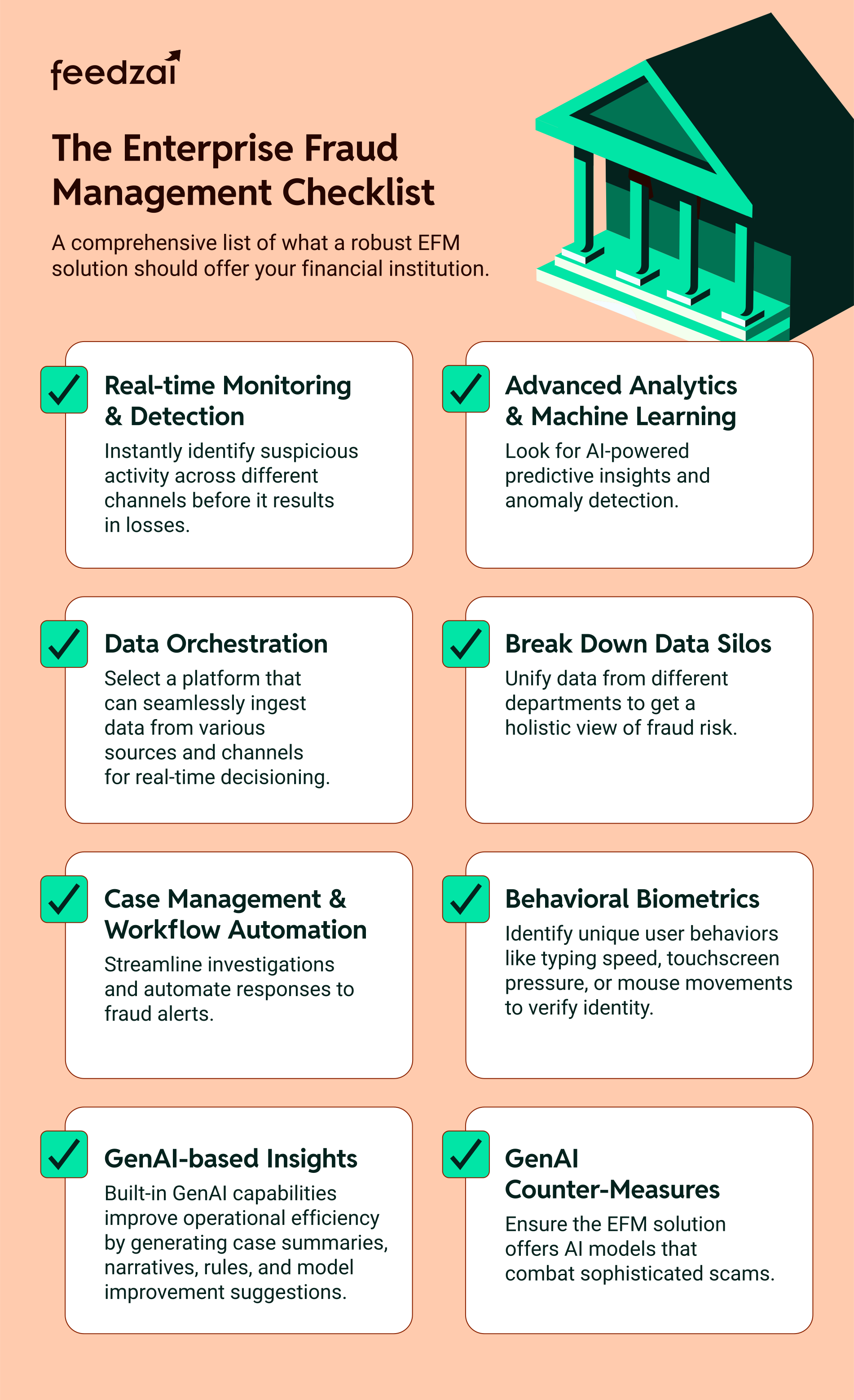
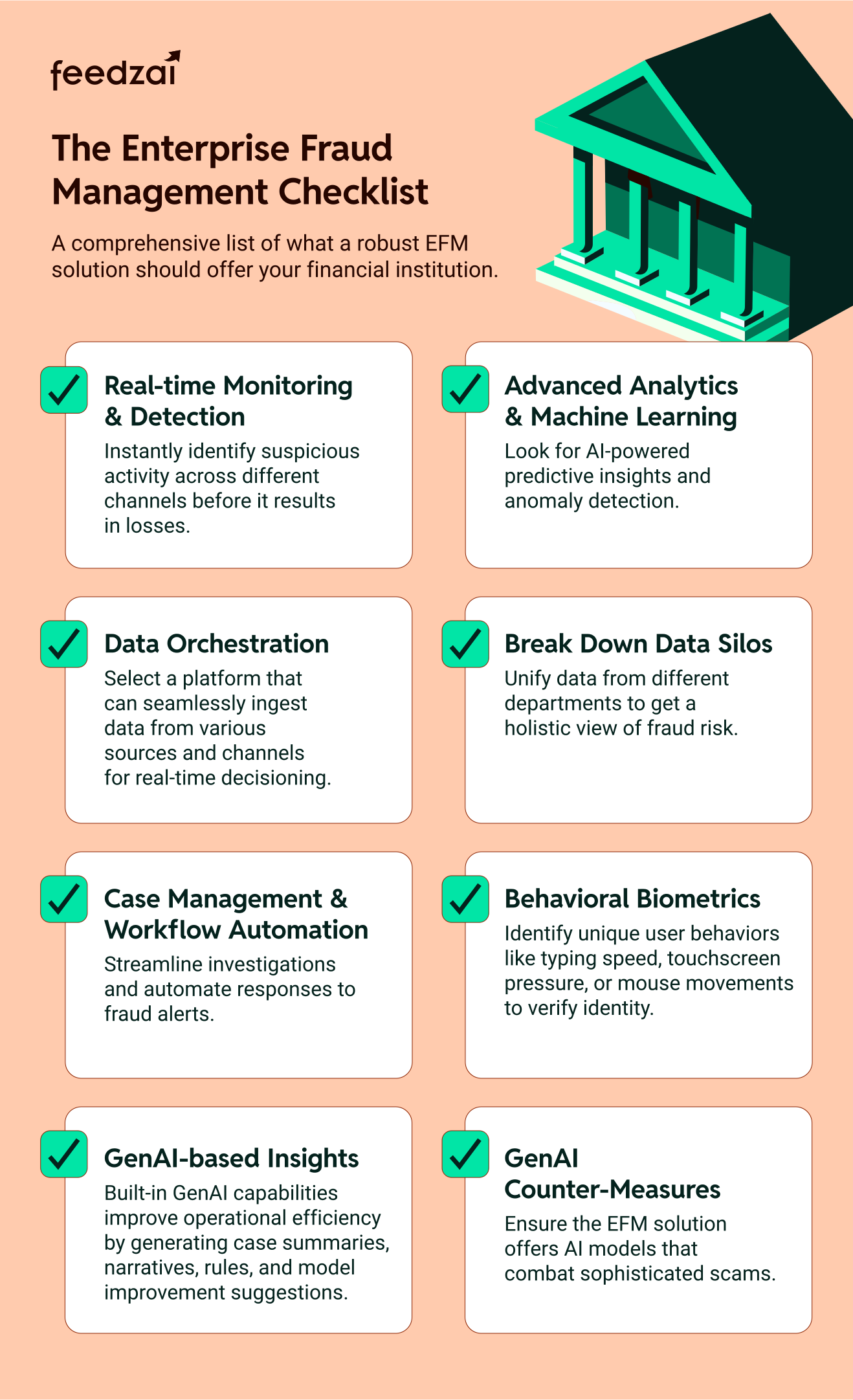
What features should you look for when selecting an Enterprise Fraud Solution?
When selecting an Enterprise Fraud Solution, prioritize these key features:
- Real-time monitoring & Detection: Identify threats instantly.
- Advanced Analytics & Machine Learning: Leverage AI for predictive insights and anomaly detection.
- Case Management & Workflow Automation: Streamline investigation and resolution processes.
- Scalability & Integration: Ensure it grows with your business and integrates with existing systems.
- Reporting & Auditing: Gain actionable insights and maintain compliance.
Footnotes
2 https://www.jackhenry.com/fintalk/2025-fraud-trends-protecting-against-emerging-threats
All expertise and insights are from human Feedzaians, but we may leverage AI to enhance phrasing or efficiency. Welcome to the future.