September 25, 2026 · 6min read
Feedzai Fusion 2026: 3 Things That Got the Room Talking

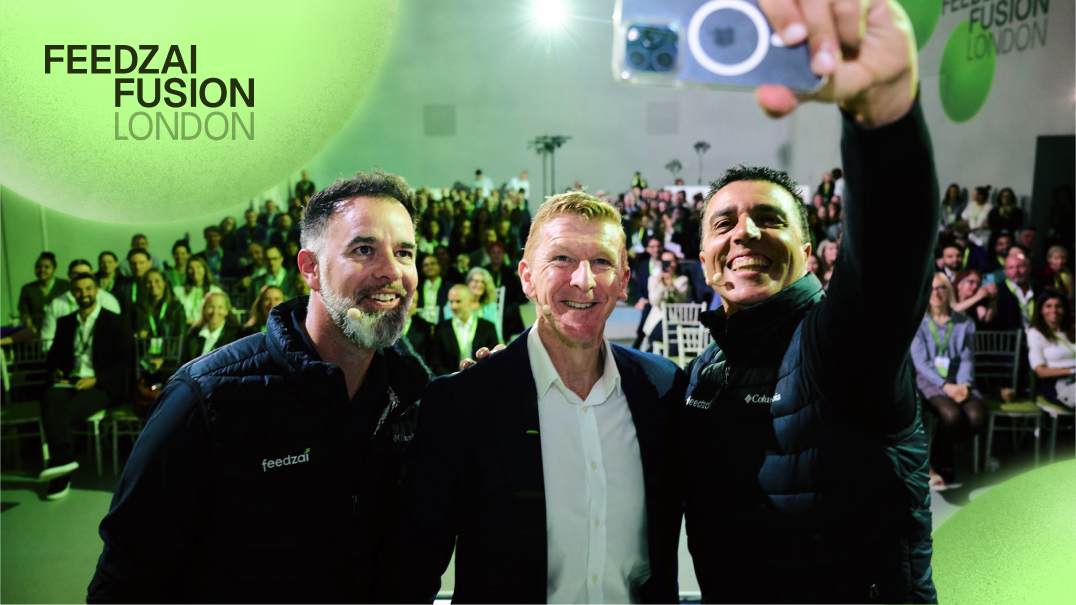
Some events give you plenty to take away, but Feedzai Fusion London 2026 gave us plenty to keep talking about.
We brought together customers, partners, and professionals from across banking, fintech, payments, technology, and the wider fraud ecosystem at Frameless in London on September 23 for a day of challenging thinking, candid discussions, and meaningful connections.
Even before sessions began, attendees connected around the networking space over the key themes reshaping the fraud landscape: fraud, scams, identity, data, AI, and more. The immersive lighting and dynamic displays continued in the main room, creating a fitting setting for urgent, forward-looking discussions among an industry undergoing rapid metamorphosis.
Feedzai CEO Nuno Sebastião opened Fusion with three words that would set the tone for the day: technology, adoption, and trust.
We know technology moves quickly, but capability alone doesn’t create transformation. Adoption has to follow, and for that to happen, people have to trust what the technology is doing.
It came up all day: in the data behind a decision, in the relationship between a customer and their financial institution, in the signals shared across an ecosystem, and in how much responsibility we’re prepared to give AI.
Farol
Fraud and financial crime keep growing more complex, but risk teams aren’t growing with them. Rising workloads, fragmented data, and […]
Here are three key themes discussed at Feedzai Fusion London that got the room talking, plus the launch that closed the day.
1. Speed Only Counts if the Decision Is Right
Astronaut Tim Peake gave us a fascinating window into how astronauts prepare to make decisions when the stakes are high, and the unexpected is part of the job.
Astronauts practice spacewalks before they ever leave Earth. Virtual reality recreates environments, people are stress-tested, and flight rules and procedures are worked through in detail.
“Failure is the best teacher,” said Peake.
For Peake, failure is something to prepare for and learn from.
He talked about preparation, resilience, and risk mitigation, but also about something particularly relevant to financial institutions: operational effectiveness.
When a decision must be made under pressure, where do the facts behind it come from? How prepared is the team? And what happens when reality doesn’t match the scenario you prepared for?
In financial crime, we talk constantly about speed: real-time detection, real-time controls, faster investigations, and faster intervention.
But speed without good information is just a faster route to the wrong decision.
Peake’s view of teamwork and leadership follows the same logic: preparation creates confidence, procedures create clarity, and resilience helps teams respond when circumstances change.
Later, Sean Hegarty from JPMorganChase shared the journey of building a digital bank in 420 working days.
Moving quickly didn’t mean designing fraud controls afterward. The framework was layered from the start, spanning onboarding, login, and transactions, so if one control is beaten, another layer provides protection.
The lessons from the launch were practical: get the design right up front, think about the full end-to-end ownership of fraud, communicate early, hire really good people, and get out of their way. It’s a good example of speed and quality working together.
2. The Right Friction Builds Trust
We’ve spent years talking about frictionless customer journeys.
But when someone’s money or identity is at risk, is zero friction really the ambition?
One of the strongest themes from the customer discussions was proportionate friction: if someone is about to make a payment while under the influence of a scammer, a pause or a targeted warning can be valuable.
A single, targeted question, informed by the payment, the payee, and the customer’s circumstances, could be enough to break the spell and make someone stop and think.
One phrase used during the discussions was “unsticking” the customer from the scam. By the time a financial institution sees the payment, a scammer may already have spent hours or even days building a story around that person. The challenge is finding the right intervention to interrupt that journey.
Build risk around the customer, not the function.
Identity, authentication, behavior, payments, and fraud may sit in different parts of an organization, but customers don’t see those silos. They only see their bank.
A more customer-centric approach means bringing more of that picture together: better data, better customer profiles, more relevant interventions, and more dynamic decisions instead of relying solely on static rules and thresholds.
It can also give fraud teams more time to focus on strategy and emerging threats. Ultimately, it creates an opportunity for safer growth.
That means asking some questions:
- Is this really the customer?
- Has their behavior changed?
- Does this payment make sense?
- Do we need to intervene?
- If so, what intervention is most likely to change the outcome?
That’s where real-time, AI-powered detection, good data, and customer experience come together, embedding fraud as a control within the business process rather than treating it as something that happens afterward.
But some of the signals needed to make these decisions may sit outside the organization.
3. Fraud is a network problem. Fighting it has to be too.
One line from the law enforcement perspective summed up the problem: “Criminals have a network. We don’t.”
A scam might start on an online platform, move through a telco, reach a customer, enter a financial institution, pass through a mule account, and continue across the financial system. Whether a mule is witting or unwitting, the wider point remains: the behavior rarely makes sense when viewed through one institution or one transaction alone.
Everyone has a piece of the puzzle, and nobody necessarily has the whole picture.
Perspectives from Stop Scams UK, Cifas, UK Finance, and City of London Police all pointed to the same challenge: no single fraud team, financial institution, or sector can solve it.
Law enforcement is seeing organized fraud alongside fragmented data. Financial institutions see another part of the picture. Telcos and technology platforms have their own signals. And industry bodies can help connect those perspectives.
One of the most interesting shifts in language from the day was the move from reactive data sharing to signal sharing.
Sharing more data doesn’t mean the right signal gets to the right place at the right moment.
A useful signal could identify someone vulnerable, expose a pattern across institutions, help identify a mule account earlier, or change a decision before the money moves.
That’s upstream intervention: finding opportunities to disrupt the fraud journey rather than responding after fraud has happened.
The human side matters too. One discussion deliberately used the word “target” rather than “victim,” because anyone can be targeted. Sometimes the intervention that changes the outcome isn’t another model. It could be better education, a trusted call, a targeted warning, or one relevant question at the right moment.
Criminals are already connected. The question is whether the organizations trying to stop them become connected enough to respond with network intelligence.
The Launch: Introducing Feedzai Farol
To close the day, the immersive setting became part of the story. Pedro Bizarro, Feedzai’s Chief Science Officer, launched Feedzai Farol through an immersive video experience, guiding the audience into the agentic era. Farol means “lighthouse” in Portuguese.
Farol brings AI agents into fraud operations, helping teams research risk, connect investigations and reporting, and manage rulesets conversationally.
The opportunity is to focus human expertise where it matters most: less time searching and maintaining, more time on strategy, judgment, and emerging threats.
Greater autonomy brings the day back to where Fusion started: technology, adoption, and trust. What should an agent do, where should the human stay in the loop, and what guardrails are needed?
Pedro framed the agentic era through three words:
- Provide agentic capabilities that help financial crime teams work smarter and faster.
- Enable teams to use agents safely and effectively.
- Protect against new threats, including those emerging from the agentic era.
Fusion opened our eyes to important truths. Technology will always move faster, threats will evolve, and agents will take on more responsibilities. What matters next is better decisions, proportionate friction, and connected networks, with trust underneath all three. The advantage is knowing what to trust, when to act, and who to connect with.
The sessions may have wrapped up. But the real conversations are only getting started.
Additional Resources
All expertise and insights are from human Feedzaians, but we may leverage AI to enhance phrasing or efficiency. Welcome to the future.