November 6, 2026 · 7min read
Beyond the Transaction: 3 Key Lessons from Feedzai Fusion São Paulo 2026


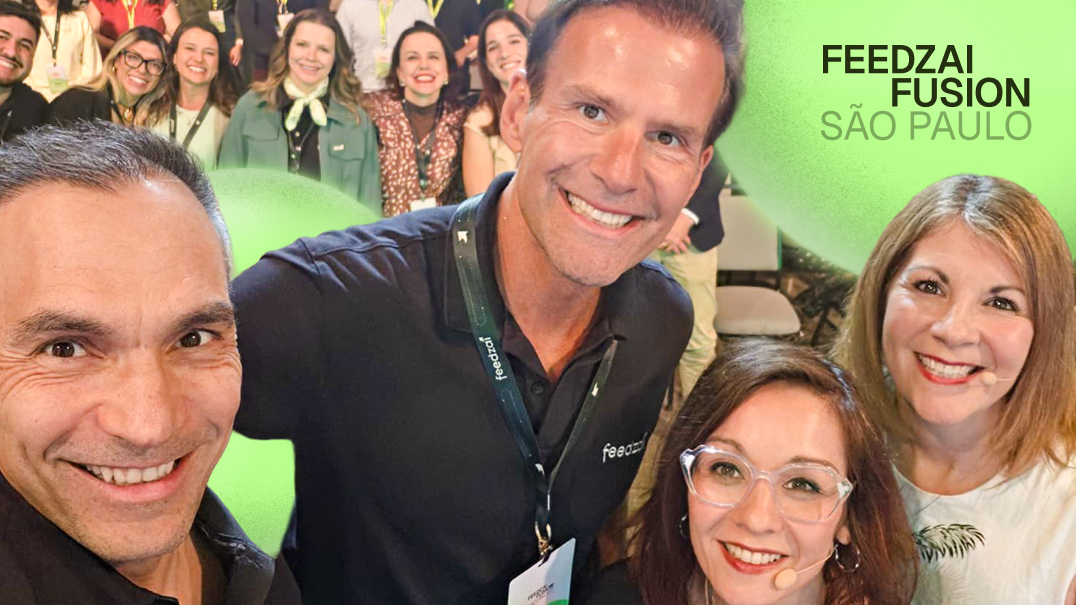
On November 5, key leaders from financial institutions, payment networks, fintech companies, regulatory bodies, and consulting firms gathered at 033 Rooftop on Avenida Juscelino Kubitschek for Feedzai Fusion São Paulo 2026. The gathering sparked dynamic discussions and generated industry-resonating insights among panelists and attendees.
The key question on everyone’s minds: How do we keep money safe when fraud, AI, and regulation are all changing at once?
The lineup matched the ambition, with Banco do Brasil, Itaú Unibanco, Rede, Sicredi, Dock, Fiserv, Mastercard, AWS, Febraban, the Global Anti-Scam Alliance, the Brazilian Federal Police, and UK Finance sharing the stage. Feedzai partners AWS, Mastercard, Matrix, and NTT continued discussions in the foyer, and the Humans in the Cosmos exhibition gave attendees a break to explore between sessions.
Talita Ribeiro, Feedzai’s Head of Regional Marketing for LATAM, opened the day. Then, Nuno Pires, Feedzai’s Head of Global Sales, posed a question for everyone in the room: If an AI agent could manage your finances, choose your investments, and make payments for you tomorrow, would you let it?
This question set the tone for the rest of the day. Here’s what stuck with us.
Trust Is the Foundation of the Agentic Era
Nuno’s keynote made a simple point: a new era doesn’t begin simply because technology can do something advanced. Instead, it begins when three key elements align: technology that works at scale, widespread adoption, and assurance that issues will be resolved swiftly.
Brazil already has proof of this, as Pix has reached more than 170 million users because it solved a real problem, and it is well-regulated and protected. Mobile banking took off in Brazil once people earned trust. Other ideas, such as refrigerators that order your groceries, never got that far because people didn’t need them.
Trust, Nuno argued, isn’t the absence of risk, but the ability to manage risk consistently at scale.
Feedzai Fraud Readiness Index 2026
The Feedzai Fraud Readiness Index 2026 surveyed 1,030 senior leaders across 12 global markets to understand how prepared the industry […]
Agentic AI is the next test, as some Brazilian customers can already manage their finances through AI assistants outside the banking app. The next step is moving money. Nuno noted that the leading institutions won’t be the ones with the most advanced models. They will be the ones that build the trust that the models require to take action.
The Preparing for Agentic Commerce panel explored this concept further. Leonardo Carissimi (Mastercard) and Luís Pereira Lima (Itaú Unibanco/Rede) discussed what is real in agentic commerce today and what is still hype. The pair spoke about how authentication, behavioral biometrics, and tokenization must evolve when humans are no longer involved, and who owns the customer relationship when agents are doing the shopping.
Technology Moves Fast. But People Still Decide.
The faster technology moves, the more results depend on something no tool delivers: how people understand each other and work together. Actress, director, author, and neuroscientist Danni Suzuki brought that idea to the stage with her talk, Humans of the Future.
She started with neuroscience. Research by neuroscientist António Damásio showed that our emotions, not pure logic, make our decisions. Even a surgeon’s or a judge’s call can shift with their mood that morning, and AI is now learning to read and simulate those emotions, sometimes better than we can.
Drawing on years of living with communities from the Alto Xingu to Alaska and Japan, Danni shared five keys for staying human in an exponential age: identity, reconnection, attunement, interconnection, and service. She pointed to Japan, the world’s most technologically oriented country, where the principle is simple: the further technology advances, the more family traditions and values need to be strengthened.
“If you aren’t sure who you are, the algorithms will sell that insecurity back to you,” said Danni.
Her message to a room full of people building AI was direct:
“The problem isn’t technology. It’s dehumanization.”
This theme returned in the Human-Centered Scam Prevention panel. Antonio Soares (Dock) and Juliano Seixas (Sicredi), moderated by Feedzai’s Fabiano Rocha Lourdes, discussed why authorized push payment scams get past technical controls: the victim is the one pressing “send.” Generic warnings like “Are you sure?” get ignored. What works is a timely, relevant intervention that breaks the spell without adding friction for legitimate customers.
Earlier, Renata Salvini (GASA) and Raphael Mielli (Febraban), moderated by Feedzai’s Fernanda Curti , set out where Brazil is heading on regulation. They covered the legal definition of mule accounts and new rules for telecoms and big tech platforms. Their shared view: regulation matters, but data sharing and ongoing consumer education decide whether institutions react in days rather than quarters.
Ultimately, the takeaway is that AI can scale both attacks and defenses. Protecting people still needs empathy, behavioral insight, and well-timed help.
Fraud Is a Network Problem And Fighting It Has to Be Too
One theme came up in almost every session: criminals don’t respect the boundaries we build.
Ruth Ray, Managing Director of Economic Crime at UK Finance, shared the UK’s lessons. Fraud, money laundering, sanctions evasion, cybercrime, and human trafficking get separate strategies, teams, and laws. But criminals run them all as one connected business. A scam that targets someone in Brazil may begin thousands of miles away, run by someone trafficked into a scam compound, with the money passing through mule accounts, shell companies, and crypto.
She was also candid about the UK’s mandatory reimbursement regime for authorized push payment scams, in force since October 2024. Victims now get more consistent outcomes and their money back. But, in her words, it has not been a success: it hasn’t stopped the fraud.
“The money still very much ends up in the hands of criminals. And that’s not a win for any of us,” said Ruth.
Her challenge to the industry was to close the gaps before criminals turn them into a business model. She outlined three key priorities:
- design the risk out of products and payment journeys from the start;
- connect intelligence so the right signal reaches the organization able to act before the money disappears;
- and measure disruption rather than activity.
The panels brought that home. In 360° Customer View, Alessandra Fruet Sperandio (Banco do Brasil) and Ronaldo Trigo (Fiserv), moderated by Feedzai’s Carolina Rezemini, discussed what it takes to break down silos between channels and why a single, real-time view of the customer helps teams launch products faster and more safely.
In The Network Mindset panel, Federal Police Chief Ivo Roberto Costa da Silva and Tatiana Orofino (AWS), moderated by Feedzai’s Kleber Gonçalves, looked at how mule networks move across dozens of banks in seconds. They discussed why monitoring incoming payments matters as much as outgoing ones, and what makes a bank’s referral something law enforcement can act on.
One bank sees one transaction. The network sees the whole picture.
The Agentic Era of RiskOps Starts Now
Feedzai Co-founder and Chief Science Officer Pedro Bizarro picked up on one of today’s biggest topics of discussion. Agents have changed the economics of fraud management. Now, users expect AI in the software they use, and soon consumers will let agents log in, pay bills, and move money on their behalf.
Unfortunately, fraudsters will use the same agents.
That changes the core question of risk management. For decades, the question has focused on whether an agent is authorized, within what limits, and with what intent.
Pedro called this “Agentic Trust” and set out three roles Feedzai will play in the agentic era:
- Protect against agentic attacks: Feedzai is building ways to detect agents, classify their intent, and tell legitimate traffic apart from agent takeovers, agent botnets, and malware, checking who authorized an agent, what it can do, and whether its behavior still matches the original intent.
- Enable agentic innovation: Just as Feedzai pioneered OpenML, Bring Your Own Agent (BYOA) lets banks connect their own or partner-built agents to the Feedzai platform, with their choice of model, through a secure connection.
- Provide agents that do the work, inside the tools fraud and AML teams already use.
The first of those agents is already live. Farol is Feedzai’s always-on AI agent, built into RiskOps Studio. Analysts talk to it in plain language, and it picks the right skills for the task, from flagging rules that haven’t caught fraud in 30 days to drafting a suspicious activity report. Early results show 13x faster rule analysis, 20% faster alert resolution, and 12x faster SAR filing.
Pedro closed with a roadmap that runs from the Agentic RiskOps launch to proactive agentic capabilities, BYOA, and agentic risk detection with Know Your Agent (KYA). His point echoed the rest of the day: AI creates the most value when it amplifies people, and the agentic era of RiskOps starts now.
From trust in AI agents to the human side of scams to the networks behind financial crime, Fusion São Paulo showed that no one solves this alone. The sessions may have wrapped up, but the work of building a safer financial system across Latin America is just getting started.
All expertise and insights are from human Feedzaians, but we may leverage AI to enhance phrasing or efficiency. Welcome to the future.