June 10, 2026 · 9min read
Feedzai IQ Score: AI Fraud Detection Powered by Network Intelligence


Fraudsters aren’t smarter than your security teams. They’re just better at sharing notes. The numbers tell a brutal story that demonstrates how global fraud is accelerating at a pace that individual institutions simply cannot match on their own.
According to Nasdaq Verafin, $579.4 billion was lost to bank fraud and scams in 2025, an increase of $53.3 billion from 2023.1 But this figure does not capture the full scale of losses that financial institutions end up quietly absorbing themselves. From authorized push payment (APP) scams, synthetic identity fraud, and AI-powered deepfake fraud, fraudsters are moving faster than legacy engines can be retrained.
Gartner® states2 “Over the years, bad actors and criminal rings have become highly organized, offering fraud as a service (FaaS), a model that enables the sale of stolen data, compromised accounts, AI tools and access to infrastructure, making it far easier for individuals with minimal technical skills to perpetrate fraud at scale.”
The root cause is structural. Most banks and fintechs are making fraud decisions based exclusively on their own historical transaction data. It’s like trying to assemble a massive jigsaw puzzle when you only hold a single piece. When a sophisticated fraud ring cycles through dozens of institutions, each one sees only a piece of the puzzle. No single institution has the visibility to connect the pieces. Fraudsters know this and are counting on this isolation.
It’s time to move beyond tackling fraud in silos. In this blog, we’ll dive deep into how Feedzai IQ Score is built specifically to close that gap by delivering network-derived intelligence through a single API without requiring institutions to replace their existing systems or expose customer data.
Key Takeaways
- Financial institutions lost $579.4 billion to fraud in 2025, according to Nasdaq Verafin.1
- Most financial institutions rely on siloed, institution-only data that is structurally blind to network-level threats.
- Feedzai IQ Score is an AI-native risk scoring solution that delivers real-time fraud intelligence via a single API, drawing on a $19 trillion global transaction network.
- Feedzai’s federated learning model means raw data never leaves the customer’s environment, enabling collective defense without compliance compromise.
How AI and Shared Intelligence Are Transforming Fraud Detection for Financial Institutions
The challenge with fighting fraud isn’t your models. It’s that if your models are only trained using your own data, they’re essentially fighting fraud with one eye closed. For most financial institutions, that data is their own transaction history, a view that excludes the 99% of the financial ecosystem operating outside their walls.
The shift toward shared, network intelligence represents the next evolution in fraud prevention. Rather than relying solely on patterns observed within a single institution, AI models can now be trained on aggregated signals drawn from across a global network. The result is a model that recognizes emerging fraud typologies, including those it has never encountered locally, because it has already seen them elsewhere in the network.
“Feedzai IQ Score puts an end to isolated defense by giving banks access to collective insights from across our entire network.” — Pedro Barata, Chief Product Officer, Feedzai
This is the foundational logic behind Feedzai IQ Score. Built on Microsoft LightGBM, an algorithm selected for its optimal balance between training speed and detection performance, the solution aggregates intelligence from:
- $19 trillion in annual payment transactions
- 140 billion annual network-wide events
- Insights based on hundreds of global organizations spanning all major payment rails.
Every scoring request is evaluated in real time against signals drawn from this collective intelligence layer. Institutions gain access to threat patterns that would be invisible to any single participant acting alone.
Master Real-Time A2A Fraud Prevention
Scams are becoming increasingly sophisticated with criminals exploiting instant payment rails and advanced technology to steal money in seconds. Learn how to stop scams before funds ever leave the account.
For organizations grappling with real-time payments fraud or the growing complexity of account takeover fraud, this network-level visibility isn’t a luxury item anymore. It’s the baseline for an effective defense.
How Feedzai IQ Score Gives Financial Institutions Visibility Beyond Their Own Data
The core value proposition of Feedzai IQ Score rests on a simple but powerful premise: fraud that one institution cannot see, the network has already seen.
Imagine a fraudster hitting a mid-sized regional bank with a sophisticated APP scam. To the bank’s internal fraud model, the transaction looks completely fine. The account is new, the counterparty looks clean, and the dollar amount is totally normal. Without external context, the threat signal is invisible.
Feedzai IQ Score changes that calculus. By connecting to the global transaction network, the solution surfaces risk signals that have been confirmed across other participating institutions. Suddenly, those blind spots disappear, exposing the patterns behind romance scams, money mules, and complex social engineering fraud typologies before they can cause damage.
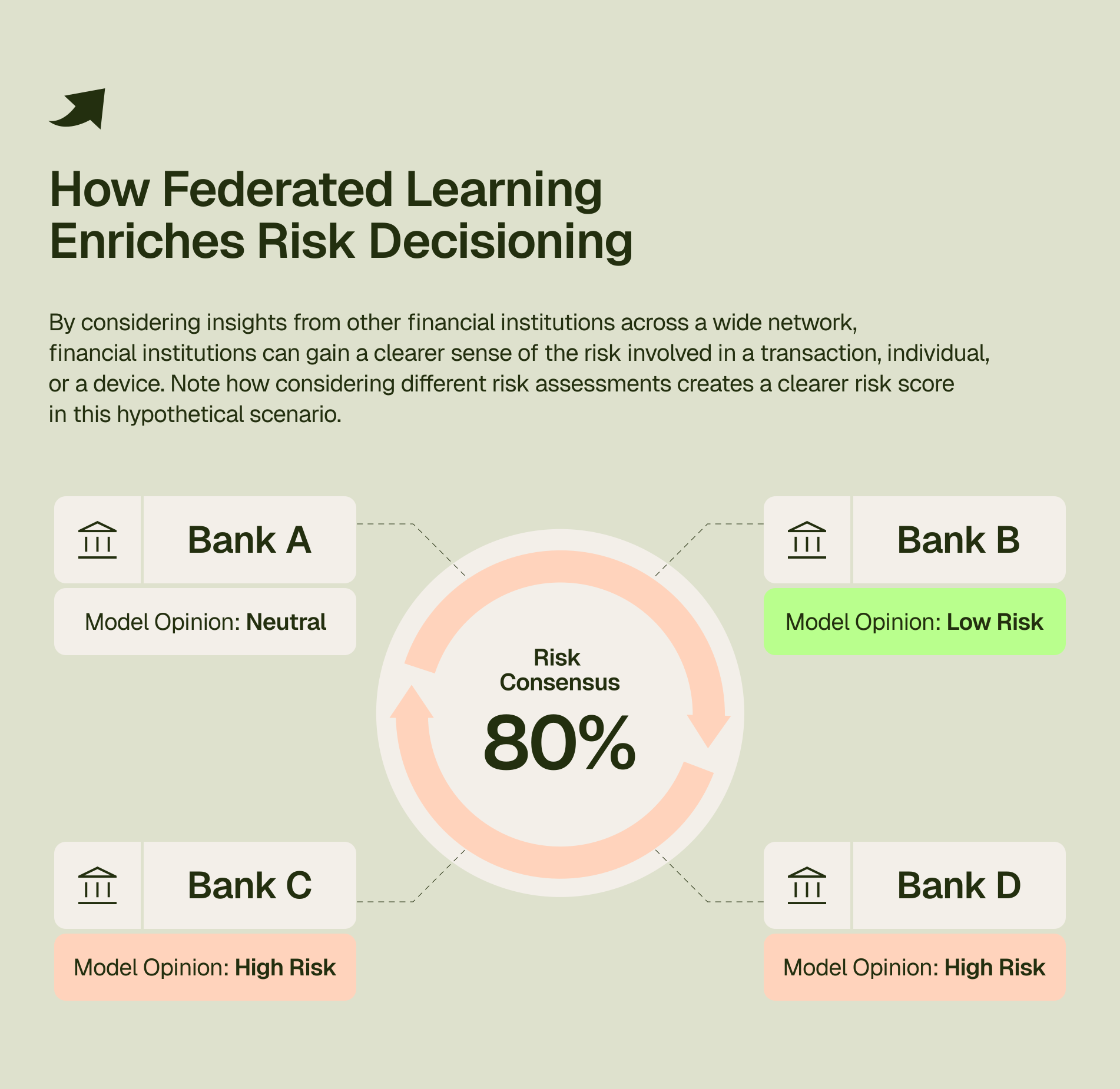
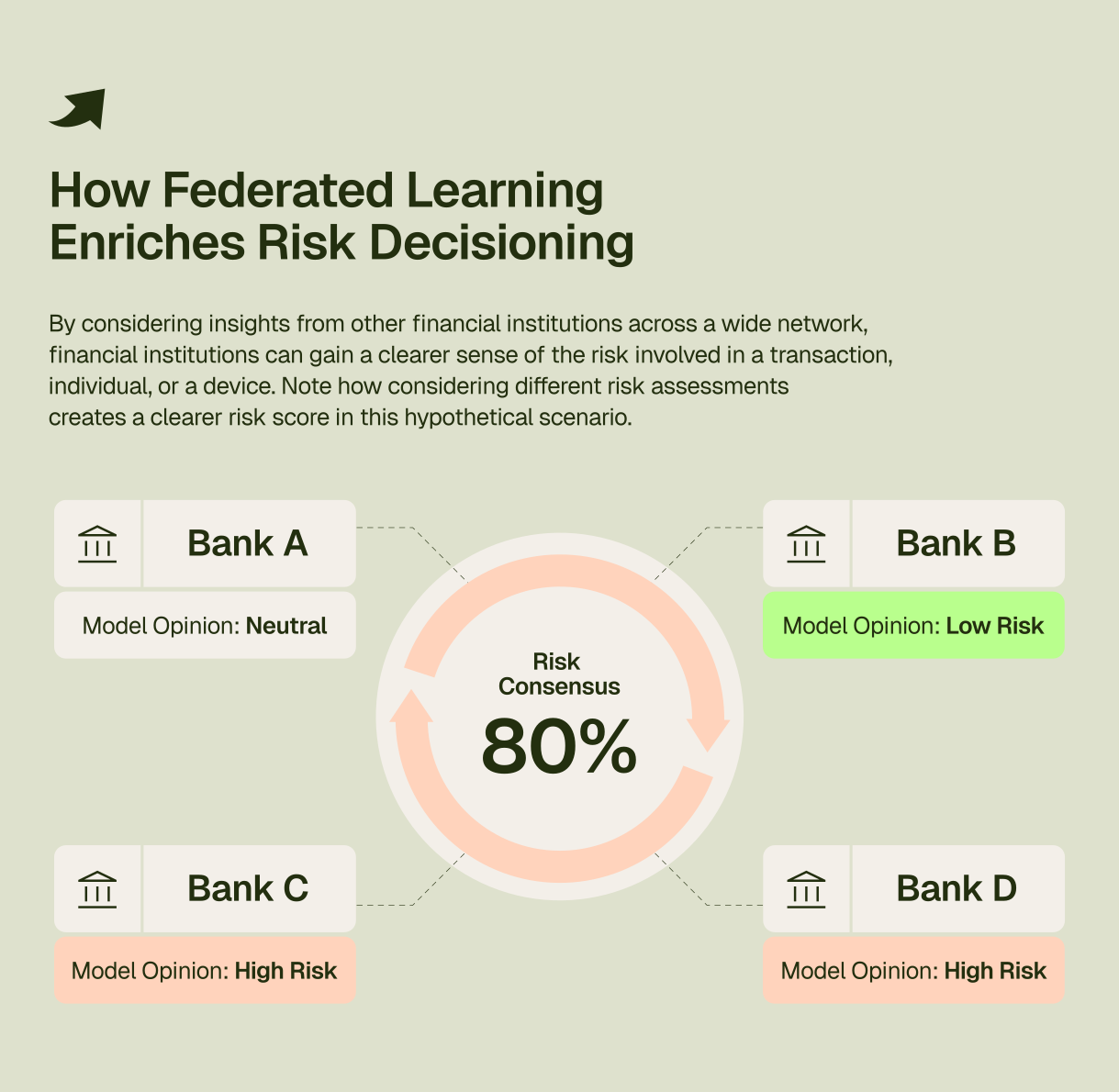
Each transaction scored through Feedzai IQ Score returns a real-time risk score on a 0-1000 scale, accompanied by whitebox explanations that explain, in human-readable terms, why a given transaction was flagged. Scores are standardized and calibrated to give your team a predictable, reliable baseline:
- Consistent thresholds: Setting your trigger threshold at 500 is designed to capture about 0.8% of your average transaction volume.
- Operational predictability: Your team always knows what to expect, no matter how much your daily transaction mix shifts.
- Actionable insights: Clear explanations mean your analysts can make confident choices in seconds.
For institutions that have spent years battling alert fatigue from legacy rules engines, this combination of high-precision scoring and transparent explainability is transformative. Risk teams can finally stop chasing noise and start acting on real signals.
How Feedzai IQ Score Helps Financial Institutions Modernize Without Replacing Existing Systems
One of the most persistent barriers to fraud technology modernization is not a lack of ambition: it’s the cost and risk of disruption. Core banking platforms are deeply embedded, regulatory approval cycles are long, and the operational risk of a failed migration is career-defining. The result is a legacy gridlock where institutions know their fraud defenses are lagging but cannot move fast enough to fix them.
Fortunately, you don’t need to tear down your entire house to upgrade your security systems. Feedzai IQ Score is designed specifically to break that bottleneck.
The solution operates as an augmentation layer, not a replacement. For institutions with an existing risk engine, it sits alongside as an augmentation layer, enriching each transaction decision with a network-derived score. For those without a primary fraud model, IQ Score can serve as the first line of defense from Day 1, with no existing infrastructure required. Whether you are augmenting an existing stack or standing up a primary defense for the first time, there is no requirement to rip out existing infrastructure, retrain incumbent models, or migrate historical data.
The integration is deliberately lightweight. Only up to 35 schema fields are required to produce a successful API call, covering transfers, cards, and payments. From contract signature to live scoring, institutions can go live in days.
Why Collective Fraud Intelligence Is Critical for Stopping Emerging Financial Crime
The current fraud ecosystem is categorically different from the one that financial institutions designed their defenses for a decade ago. Pig butchering scams, generative AI fraud, and new account fraud typologies are evolving faster than any single bank can update its models. APP fraud losses, in particular, have reached crisis levels in markets like the UK, where new mandatory reimbursement rules are creating direct financial liability for institutions that fail to prevent them.
The common thread across all of these threats is that they exploit the gap between what individual institutions can see and what is actually happening across the financial ecosystem. Fraudsters actively exploit the fact that financial teams are frequently trapped inside their own data silos.
Think back to the jigsaw puzzle example:
- The Money Mule: A single mule account might pull funds from 40 different institutions within a week; however, each bank only sees their own single transaction piece.
- The Device Fingerprint: A phone or laptop tied to a massive fraud ring might trigger red flags at 15 banks, but bank number 16 approves the device because it’s never been seen before.
- The Social Engineering Script: A scammer using a highly effective script can successfully manipulate dozens of victims. To the bank encountering this behavior for the first time, it looks like a completely normal, benign customer interaction.
Collective intelligence closes these gaps. When fraud confirmed at one institution immediately strengthens the detection capability of every other institution in the network, the asymmetry shifts. The fraudster’s advantage of operating across institutional silos is eroded. The network learns faster than any isolated team ever could on its own.
This is what Feedzai IQ Score delivers. For institutions facing board-level pressure to demonstrate modern, layered fraud defenses or regulatory scrutiny, the ability to point to a network-derived scoring layer processing over $9 trillion in annual transaction intelligence is a substantive response.
How Feedzai’s Federated Learning Approach Enables Privacy-Safe Fraud Detection at Scale
For many institutions, the instinctive response to “share data with the network” is “our legal team will never approve it.” That instinct is correct for traditional consortium models, which typically require raw data to be pooled in a central repository accessible to all participants. The compliance risk, data sovereignty implications, and reputational exposure of such arrangements have historically made large financial institutions reluctant to participate.
Feedzai’s approach is architecturally different. Feedzai IQ Score is built on federated learning, a machine learning technique in which the model is trained without raw data ever leaving a customer’s environment.
In practice, this means each institution’s transaction data remains fully segregated within its own infrastructure. The network does not share raw records, customer identities, or personally identifiable information (PII). Instead, the system extracts anonymized risk signals, fraud patterns, and aggregated metadata trends at the individual environment level, then aggregates these signals at the Feedzai network level. What moves across the network is intelligence, but never data.
The privacy architecture is reinforced by strict quality controls on which data sources contribute to network scoring. To qualify as an “expert model” in the network, a data source must contain at least six months of continuous data and a minimum of 5,000 fraud labels. Each candidate model is validated against ROC curve analysis and tested for overfitting before admission to the pool. A posterior-correction algorithm is applied during calibration to align expert models within a controlled range and identify any models exhibiting natural bias, which are automatically excluded.
For institutions in highly regulated markets, including those subject to GDPR in Europe or stringent local data residency laws, this privacy-first architecture enables participation in collective defense while maintaining full compliance. It eliminates the data trade-off that has historically forced institutions to choose between network intelligence and data sovereignty.
How Feedzai IQ Score Improves Fraud Detection ROI With a Single API Integration
The business case for Feedzai IQ Score is simple: it delivers measurable performance within your first week of operation, not your first year.
That Day 1 performance advantage stems directly from the network effect. Because the underlying model is trained on confirmed fraud patterns from the global transaction network, a new participant does not need to accumulate years of historical fraud labels before their model becomes effective. The intelligence is already there, embedded in the global model, waiting to be applied. Think of it as being handed the completed picture on the jigsaw puzzle box.
For institutions augmenting existing defenses rather than replacing them, the ROI case is equally compelling. For augmentation deployments, the IQ Score plugs into the existing risk engine as an additional signal, improving detection rates on the transaction volume that was already being processed. For institutions deploying it as a primary model, it delivers enterprise-grade fraud detection from the first transaction, with no legacy baseline required, no additional infrastructure cost, no model management burden, and no migration risk. The net effect is a measurable improvement in the ROI of the existing tech stack.
The lightweight API design reinforces the economics of integration, as it does not require dedicated engineering resources over the course of a multi-month project. It works alongside the current system without replacing it.
Building a Collaborative Defense Against AI-Powered Fraud and Scams
The data you need to stop the most sophisticated scams isn’t missing. It’s just sitting across the network.
Feedzai IQ Score is built on the conviction that a collaborative defense that doesn’t require data sharing or disruption is technically achievable and commercially practical. This solution provides financial institutions with a genuine alternative to their historical binary choice: accept the blind spots that come with siloed detection, or absorb the risk and cost of a full platform migration.
The alternative is a single API call. It delivers collective intelligence in real time for every fraud decision an institution makes, without replacing any existing systems or sharing any customer data records.
For institutions ready to transition from a reactive to a proactive approach to fraud defense, the path forward is clear. The question is not whether network intelligence is necessary; rather, it is how quickly it can be deployed. When banks stop fighting fraud in silos and start collaborating with each other, that is how we build a world of safer money.
Additional Resources
- Blog: How Network Intelligence Is Reshaping Real-Time A2A Fraud Prevention
- Solution Brief: Stop Fraud You Can’t See
- Report: Redefine Financial Risk Detection with AI
- Solution: Feedzai IQ Score
FAQs about Feedzai IQ Score
How does Feedzai IQ Score improve fraud detection accuracy?
Feedzai IQ Score draws on confirmed fraud signals from a $19 trillion global transaction network, giving institutions visibility into fraud patterns that their own data cannot surface.
Can Feedzai IQ Score help detect authorized push payment (APP) fraud?
Yes. APP fraud is one of the use cases the solution is designed to address. By evaluating every transfer against network-level risk signals, including patterns associated with mule accounts, social engineering scripts, and known fraud rings, Feedzai IQ Score can flag high-risk activity before money leaves the account, in milliseconds.
What data is required to integrate Feedzai IQ Score?
Integration requires up to 35 schema fields, varying slightly depending on the use case (transfers, cards, or payments). No historical fraud labels, model training data, or raw customer data needs to be shared. Institutions can go live in days, instead of weeks.
Does Feedzai IQ Score replace an institution's existing fraud platform?
This depends on the institution’s starting point. For institutions with an existing risk engine, Feedzai IQ Score is designed to coexist with it as an augmentation layer, enriching decisions with network-derived intelligence without requiring any rip-and-replace. For institutions without a primary fraud model, or those looking to move away from legacy systems, IQ Score can serve as the primary defense from Day 1. Either way, no disruptive migration is required.
Footnotes
All expertise and insights are from human Feedzaians, but we may leverage AI to enhance phrasing or efficiency. Welcome to the future.